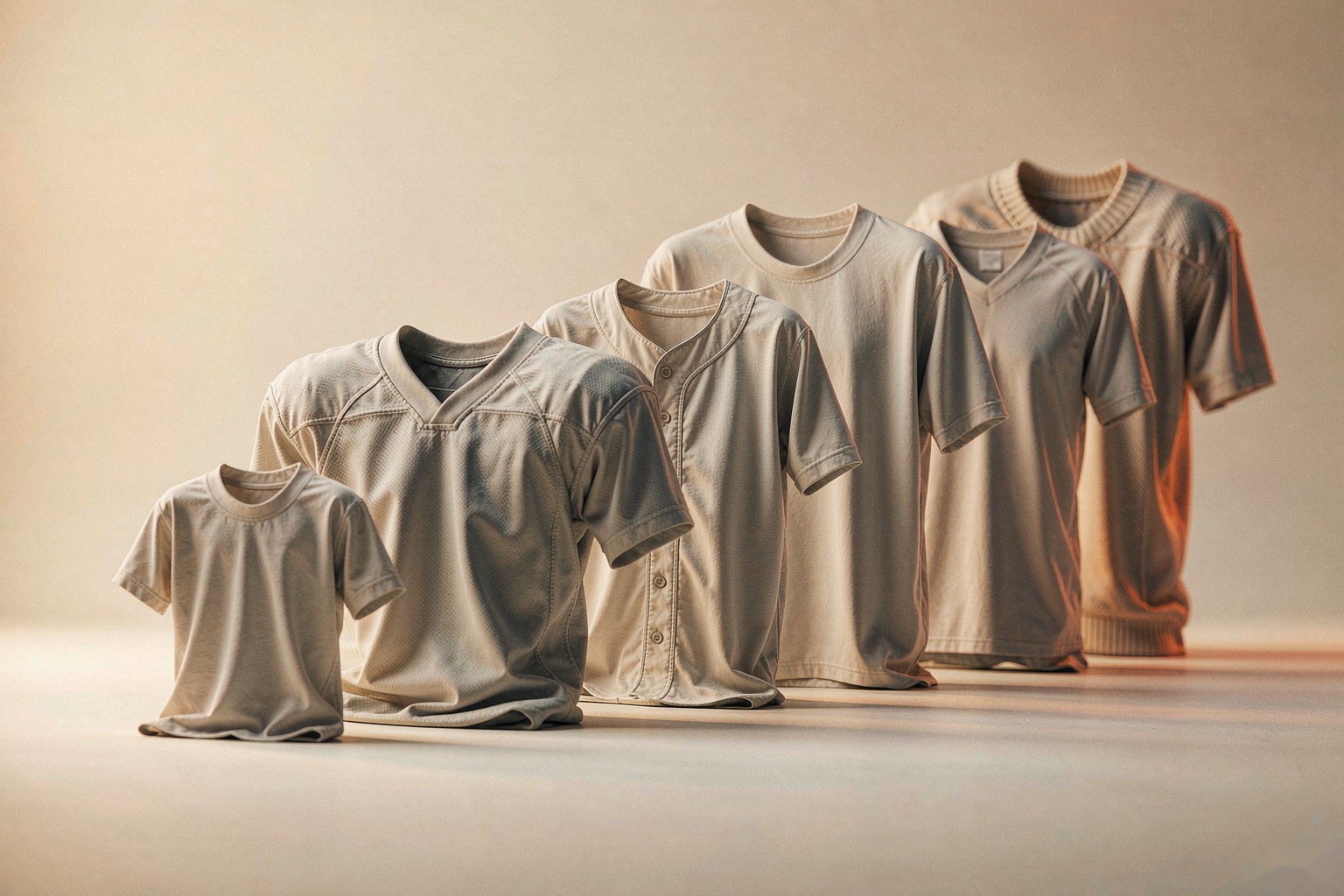
A football jersey and a soccer shirt can both say L and still sit six inches apart across the chest. This is the hub for every size chart we publish — start with the cross-league finder below, then open the full guide for the sport you are buying.
The 30-second answer
Find your chest on the left. The rest of the row tells you which size to order in each sport.
| Your Chest | Chest (cm) | Soccer | NBA | NFL | MLB | NHL |
|---|---|---|---|---|---|---|
| 33–35" | 84–89 | XS–S | S | S | S | S |
| 35–37" | 89–94 | S | S–M | S | S–M | S |
| 37–40" | 94–102 | M | M–L | M | M | S–M |
| 40–43" | 102–109 | L | L | L | L | M |
| 43–47" | 109–119 | XL | XL | XL | XL | L |
| 47–51" | 119–130 | 2XL | 2XL | 2XL | 2XL | XL |
| 51–55" | 130–140 | 3XL | 3XL | 3XL | 3XL | 2XL |
| 55"+ | 140+ | 3XL | 3XL | 4XL | 3XL | 3XL |
Chest measured under the arms, tape level across the fullest part of the chest. If you land between two bands, take the larger one.
Why the same letter fits differently
Start hereEvery sport has its own house cut, and those cuts have barely changed in decades because fans expect them. A hockey sweater is deliberately enormous so it can go over pads. A soccer shirt is deliberately close because it is built for movement. A baseball jersey is buttoned and hangs longer at the back. None of that is a sizing error — it is the silhouette.
| League | Fit Type | How It Should Feel |
|---|---|---|
| Soccer | Athletic / slim | Close to the body; size up for a looser look |
| NBA | Standard / slightly long | Relaxed through the chest, longer hem |
| NFL | Roomy / boxy | Classic oversized game-day look |
| MLB | Full / button-front | Relaxed traditional baseball cut |
| NHL | Very loose | The loosest cut of all leagues — order your true size, no need to size up |
The practical takeaway: do not carry your size over from one sport to another. If you wear an L in soccer, that same L in football will feel boxy and in hockey it will feel like a different garment entirely. Use the column that matches the sport you are buying.
How to measure yourself in two minutes
Do this onceYou need a soft tape and one jersey you already like the fit of. Measure the garment flat rather than your body — it removes the guesswork about how you like things to sit.
- Chest — the one that decides your size. Lay the jersey flat and measure straight across from one underarm seam to the other. Double it.
- Body length. From the highest point of the shoulder down to the bottom hem. This is where the sports separate most.
- Sleeve. From the shoulder seam along the outside to the sleeve opening. The single most important column in hockey.
- Waist (shorts and pants). Measure the waistband flat with the elastic relaxed, then double it.
- Compare, do not convert. Write your chest number down, find that band in the chart for the sport you are buying, and order that size.
Measure a jersey you already own, not your body. It is faster, and it captures how you like a jersey to sit rather than a bare number.
The cross-league size finder
One table, every sportThis is the fastest answer to “what size am I?” across all five sports. Read your chest band from the left and take the letter under the sport you are buying. College jerseys don't appear as a column because they inherit the cut of their sport — use the sport's column instead.
| Your Chest | Chest (cm) | Soccer | NBA | NFL | MLB | NHL |
|---|---|---|---|---|---|---|
| 33–35" | 84–89 | XS–S | S | S | S | S |
| 35–37" | 89–94 | S | S–M | S | S–M | S |
| 37–40" | 94–102 | M | M–L | M | M | S–M |
| 40–43" | 102–109 | L | L | L | L | M |
| 43–47" | 109–119 | XL | XL | XL | XL | L |
| 47–51" | 119–130 | 2XL | 2XL | 2XL | 2XL | XL |
| 51–55" | 130–140 | 3XL | 3XL | 3XL | 3XL | 2XL |
| 55"+ | 140+ | 3XL | 3XL | 4XL | 3XL | 3XL |
Because the cuts differ so much, the same chest can land on the same letter in two sports and still give you two very different garments. Treat the letter as a starting point and the sport's fit as the deciding detail.
Size guides by sport
Six guidesEach guide below carries the full charts for that sport — men’s, women’s and youth where they exist — plus the extra pieces that belong with it: shorts for basketball and soccer, pants for baseball, hoodies for football and hockey.
NFL Jerseys
Cut wide through the body with a hip-length hem, built to be worn over a t-shirt.
Read the NFL size guide →Standard / longNBA Jerseys
Wide at the shoulder and long in the hem so the jersey sits over shorts.
Read the NBA size guide →Full / button-frontMLB Jerseys
Buttoned at the front, so the placket does not stretch and the flat chest decides.
Read the MLB size guide →Very looseNHL Jerseys
The loosest cut we carry, with a long raglan sleeve that reaches the wrist.
Read the NHL size guide →Athletic / slimSoccer Jerseys
The closest-fitting shirt we carry, slim through the chest and short in the body.
Read the Soccer size guide →Follows the sportNCAA Jerseys
College jerseys inherit the cut of the sport they are made for, not a college block.
Read the NCAA size guide →Youth, toddler and women’s sizing
Separate chartsYouth jerseys run on age, height and chest together, which is why the chart has three columns — a tall nine-year-old may need to move up a size on height alone.
| Size | Ages | Chest (in) | Chest (cm) | Height (in) | Height (cm) | Weight (lb) |
|---|---|---|---|---|---|---|
| S | 7–8 | 26–27 | 66–69 | 50–54 | 127–137 | 55–70 |
| M | 9–12 | 28–30 | 71–76 | 55–60 | 140–152 | 75–95 |
| L | 13–15 | 31–33 | 79–84 | 61–63 | 155–160 | 100–120 |
| XL | 16–18 | 34–36 | 86–91 | 64–67 | 163–170 | 125–145 |
| Size | Ages | Height (in) | Height (cm) | Chest (in) | Chest (cm) | Weight (lb) |
|---|---|---|---|---|---|---|
| 2T | 2 | 33–35.5 | 84–90 | 21 | 53 | 26–29 |
| 3T | 3 | 36–38.5 | 92–97 | 22 | 56 | 30–34 |
| 4T | 4 | 39–41 | 99–104 | 23 | 58 | 35–39 |
Women’s jerseys are cut on their own blocks, with a narrower shoulder and a shorter body than the men’s equivalent. The chest band still decides the size. If you prefer a longer body, order the men’s size closest to your chest measurement rather than sizing up in the women’s cut.
Shorts, pants and layering pieces
Waist decidesShorts and pants are sized on the waist, not the chest, and most pairs we carry use an elastic waistband with a drawstring — roughly two inches of tolerance either way. Do not assume your jersey size is your shorts size.
| Size | Waist (in) | Waist (cm) | Hip (in) | Hip (cm) | Shorts Length (in) | Length (cm) |
|---|---|---|---|---|---|---|
| S | 29–32 | 74–81 | 35–37.5 | 89–95 | 18–19 | 46–48 |
| M | 32–35 | 81–89 | 37.5–41 | 95–104 | 19–20 | 48–51 |
| L | 35–38 | 89–97 | 41–44 | 104–112 | 20–21 | 51–53 |
| XL | 38–43 | 97–109 | 44–48 | 112–122 | 21–22 | 53–56 |
| 2XL | 43–47 | 109–119 | 48–52 | 122–132 | 22–23 | 56–58 |
| 3XL | 47–52 | 119–132 | 52–56 | 132–142 | 23–24 | 58–61 |
- Shorts: waist and hip decide. Between bands, the drawstring holds the larger size.
- Pants and joggers: the inseam matters more than the waist.
- Jackets and hoodies: cut to layer over a jersey — keep your normal size rather than sizing down.
Every product page carries its own chart where one exists. When a product chart and a general chart disagree, the product chart wins — fabric and cut change between runs.
International conversions
Buying from abroadThe letters on our charts are US sizes. Convert first, then read the sport chart — that order is far more reliable than guessing from a letter you recognize.
| US (Our Size) | EU / DE | UK | Italy | France | Japan | China |
|---|---|---|---|---|---|---|
| XS | 44 | 34 | 44 | 40 | S | 160/84A |
| S | 46 | 36 | 46 | 42 | M | 165/88A |
| M | 48–50 | 38–40 | 48–50 | 44–46 | L | 170/92A |
| L | 52 | 42 | 52 | 48 | XL | 175/96A |
| XL | 54 | 44 | 54 | 50 | XXL | 180/100A |
| 2XL | 56–58 | 46–48 | 56 | 52 | 3XL | 185/104A |
| 3XL | 60 | 50 | 58 | 54 | 4XL | 190/108A |
| US (Our Size) | EU / DE | UK | France | Italy | Japan |
|---|---|---|---|---|---|
| XS | 34–36 | 6 | 36 | 38 | 5–7 |
| S | 36–38 | 8 | 38 | 40 | 9 |
| M | 38–40 | 10 | 40 | 42 | 11 |
| L | 40–42 | 12 | 42 | 44 | 13 |
| XL | 42–44 | 14 | 44 | 46 | 15 |
| 2XL | 44–46 | 16 | 46–48 | 48 | 17 |
| US (Our Size) | Waist (in) | EU / DE | UK | Italy | France | Japan |
|---|---|---|---|---|---|---|
| S | 29–32 | 44–46 | 30–32 | 44–46 | 38–40 | 76–81 |
| M | 32–35 | 48 | 32–34 | 48 | 40–42 | 81–89 |
| L | 35–38 | 50 | 34–36 | 50 | 42–44 | 89–97 |
| XL | 38–43 | 52–54 | 36–38 | 52–54 | 44–46 | 97–109 |
| 2XL | 43–47 | 56–58 | 38–40 | 56 | 48–50 | 109–119 |
| 3XL | 47–52 | 60 | 40–42 | 58–60 | 52–54 | 119–132 |
Bottoms convert on a different scale from tops, so do not carry a top conversion across to shorts.
Sizing questions we get most
Which size guide should I use?
The one for the sport the jersey was made for. A college jersey uses the chart of its sport, not a separate NCAA chart, and the same is true across the store. If you only want one table, the cross-league finder above answers most questions.
Should I size up for a football or hockey jersey?
No — those two are already the roomiest cuts we carry. NFL is boxy by design and NHL is the loosest of all. Order your true chest size in both, and size up only for a deliberately oversized look.
My chest falls between two sizes. Which do I take?
The larger one, in every sport. Jerseys are not tailored garments, and adjacent sizes differ by roughly 2–3 inches across the chest. Going up leaves room to move; going down gives you a fitted jersey you cannot loosen later.
How do I know which measurement to trust — my body or my old jersey?
Your old jersey. Measuring a garment you already like captures both your size and your fit preference in a single number.
Can I return a jersey if the size is wrong?
Yes. Returns are open for 30 days from delivery with the tags attached and the jersey unworn. Start the return from your order confirmation email — full details are on our Returns & Exchanges page.
Do you publish a chart for every product?
Where a product page carries its own chart, that chart is the one to use. This hub and the sport guides cover the standard cuts; product charts catch the exceptions.
Measure twice, cheer once
Free shipping on orders over $68 · 30-day returns
These are the general cuts we carry, measured flat. Where a product page publishes its own chart, that chart reflects the specific production run and should be used instead.


